Showing posts with label spring blooming. Show all posts

Friday, March 25, 2016

Wildflowers of Pinnacles

Goldfields surround California Buckwheat with Machete Ridge in the distance

On the first day of Spring, my wife and I set out in search of wildflowers and adventure. We found both at Pinnacles, the newest National Park (2013), just 100 miles from our house.

The adventure came in the form of some unexpected spelunking at Balconies Cave, located along the Balconies Cave trail. Thanks to recent rains, the entrance to the cave was a stream. Fortunately, we were both wearing somewhat waterproof shoes.

Trail leading to Balconies cave
The cave required a headlamp and some courage, as it was pitch black and filled with slick water-soaked rocks. Unfortunately, I had no headlamp and was carrying a large camera and Nalgene bottle; not an ideal setup for navigating a damp dark passage. Thanks to a borrowed flashlight, we managed to work our way through the short but harrowing "trail" through the cave, emerging on the other side with pulled muscles and soaked shoes and socks. It's Hell getting old!

The remainder of Balconies Cave trail was a pleasant stroll through vibrant wildflower-filled meadows, cool moist canyons and along ridges adjacent to majestic rock formations. We were treated to a wonderful variety of wildflowers and beautiful blue skies.

Here is a sampling of what we saw along the trail:

Goldfields forever

Buck brush (Ceanothus)

Indian paintbrush and fiddlenecks

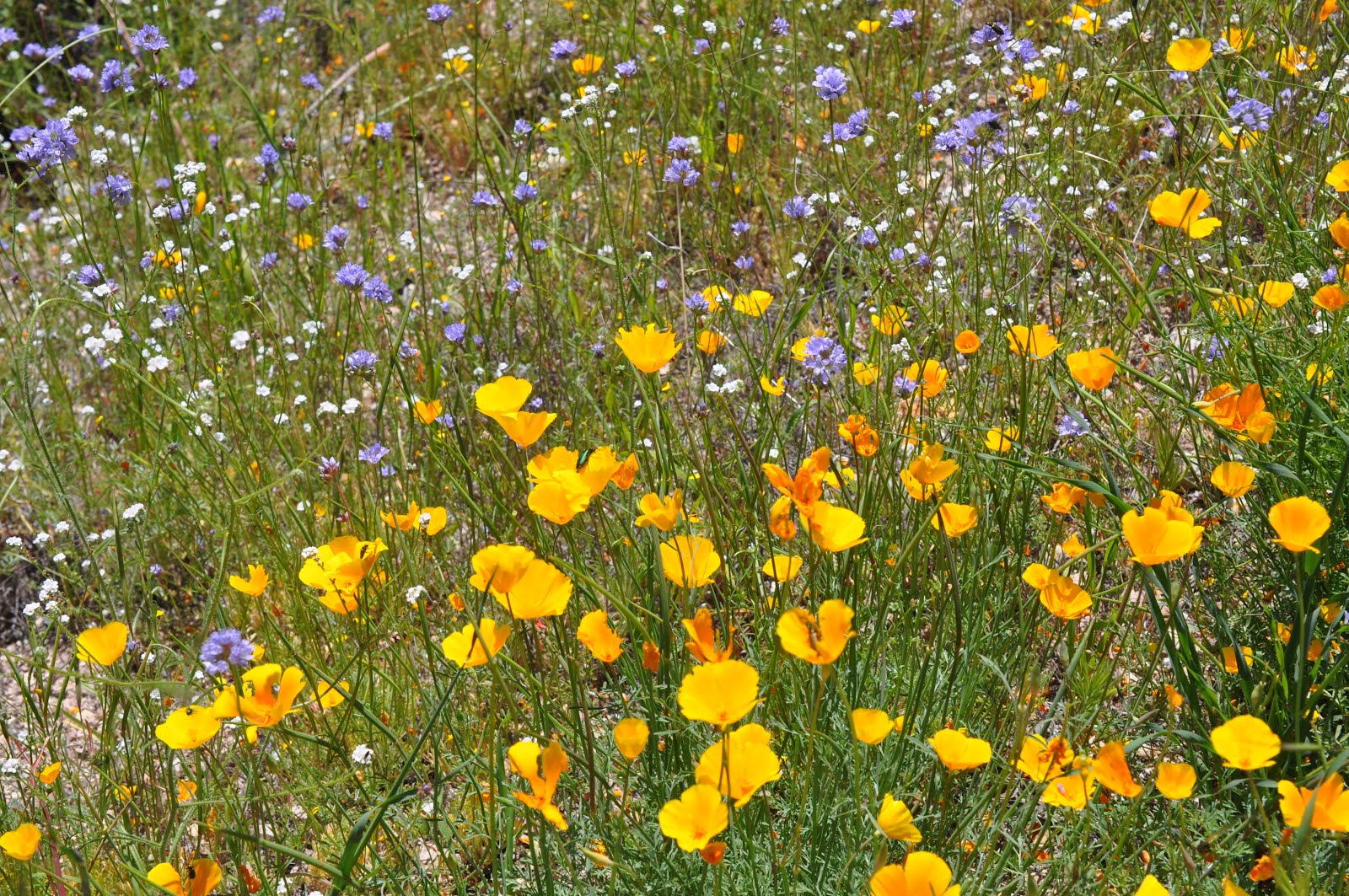
California poppies and Gilia

California buttercup in the shadow of ancient Oaks
California buttercup (Ranunculus californicus) up close and personal

Party time! Blue and White Fiesta flowers mingling with fiddlenecks

Miner's lettuce, thriving in cool moist shade
Miner's lettuce close-up


Saturday, March 19, 2016

On the Eve of Spring...

Lewisia cotyledon 'Sunset' at home in a rock wall

With the official start of Spring around the corner, I thought I'd share some scenes from around the garden. Thanks to the recent rains, foliage is looking lush and flowers are popping up everywhere. 

Heuchera, or Coral Bells, are among my favorite natives because the long-lasting flowers are among the first to appear in late Winter and come in colors ranging from cream to dark pink. They look incredible when planted in mass in a shady spot and are amenable to transplant and dry conditions.

Variety of Coral Bells lining a path

Inspired by walks along the Gray Whale Cove trail in Montara, I planted a collection of yarrow, beach strawberry and checkerbloom underneath our ancient lemon tree. Dale the snail approves.

Dale happy hiding amongst the yarrow, checkerbloom and beach strawberry

One of the most reliable year-round bloomers is the Island Bush Poppy, a crowd favorite that thrills with its large yellow flowers and attractive large grey-green leaves. Rains will knock the flowers down but they always bounce back with a couple days of sunshine.

Island bush poppy, Dendromecon harfordii, center of attention

Another plant that people often ask about is the Cliff-maid or broad-leaf Lewisia. These diminutive guys come in a variety of colors and bloom for a couple months starting in late February. They need good drainage and native plant books recommend using as a container plant. I have a couple planted into the rock wall and they seem happy, except in the summer heat.

Lewisia cotyledon 'Magenta'

Another one of my favorite natives is the California phacelia, a bee magnet that blooms early and often. Looks great in a rock garden with full sun and will appreciate some room to grow. I picked up this plant at Mission Blue nursery in Brisbane a couple months back and it is already filling in nicely.

California phacelia, Phacelia californica, in mid-March

Foothill penstemons make a great addition to a drought tolerant landscape. Their blue-purple flowers are eye catching and look great with other Spring bloomers such as monkeyflowers, poppies, sulfur buckwheat and golden aster. This particular variety, Margarita BOP, is a robust bloomer and probably the easiest to find in nurseries.

Foothill penstemon, Penstemon heteropyllus, doing it's thang


Tuesday, March 1, 2016

A partly sunny bed of natives


Clumps of Douglas Iris hybrids encircle a currant shrub
The backyard is divided into various collections of plants based on their sun exposure. Some receive full sun, some part sun, and some full shade. Some are on drip irrigation, some are not. Typically these "islands" of plants feature a centerpiece shrub, raised on a berm, surrounded by colorful perennials. 

This particular plant grouping is shaded much of the day by a large avocado tree, but does receive sun at various times of the morning and afternoon. The specimen shrub of the "island" is a 3 year old 'Barrie Coate' pink-flowering currant that begins flowering in January and continues into early April. It is surrounded by several Douglas iris hybrids ranging in color from dark purple to white. These begin flowering in late February and continue to mid April. This space is also shared with two western sword ferns that lie on either side of a bird bath and California polypody plants that appear seasonally from Fall to late Spring. Finally, two 'Point Reyes' groundcover manzanitas are situated inbetween the bird bath and a step stone path. The foliage of the manzanitas is dark green, providing a nice contrast with bright green of the neighborning ferns. The manzanitas are covered with small white/pink flowers in late Winter. This bed of plants is outfitted with drip irrigation for those times of extended drought. I give them 5 minutes of water a couple times a week, just to keep them looking fresher.


Iris douglasiana 'Canyon Snow,' the first of the irises to bloom this year
Western Sword fern, Poystichum munitum

Pt. Reyes bearberry, Arctostaphylos uva-ursi 'Pt. Reyes'
California Polypody, Polypodium californicum
Ribes sanguineum glutinosum 'Barrie Coate' in February


Friday, May 8, 2015

The 2015 Going Native Garden Tour

Such a wonderful sight to see visitors admiring your work

We recently opened up our gardens to the public as part of the 12th annual Going Native Garden Tour www.gngt.org, a celebration of California native plants in Santa Clara and San Mateo counties. This was our second year on the tour, and once again we were the only San Mateo representative. This may change for next year, however, as several folks from surrounding neighborhoods expressed an interest in participating in the near future. 

Over the course of six hours, we received 117 visitors, up from 100 last year. California's current drought crisis could be responsible for the increased traffic, as people begin to consider drought tolerant alternatives to their lawns. There were lots of questions about the best way to remove a lawn and I detailed my experiences converting our front and backyards from crab grass into thriving native landscapes. Sheet mulching worked extremely well for us and I will continue to advocate this method of lawn removal. One day I hope to create a blog post `explaining the sheet mulching process.

A view of the front yard during the Garden Tour
Feedback from visitors was overwhelmingly positive. It is extremely gratifying to hear kind words from so many strangers. As a novice gardener, I am often filled with doubt and insecurity. Encouraging words go a long way in bolstering confidence and providing the drive to continue advocating for native gardening. 

A special thanks to all those friends and family that helped make this possible; especially my wife for sacrificing her Sunday and for her daily encouragement. 

My lovely wife and biggest supporter


Sunday, May 12, 2013

Monkey-flowering Around

Image
White monkeyflower (Mimulus bifidus 'White')
Shrubby monkeyflowers (genus Mimulus) are a common site in the Bay Area, especially in the coastal scrub plant communities where they grow happily alongside sagebrush, chamise, coffeeberry, and others. In the spring, the plentiful orange flowers of Mimulus aurantiacus add a welcome dash of color to the greens and grays that typically dominate the landscape. Leaves have a characteristic sticky feel and plants can have a gangly, disheveled appearance in the wild.

In the garden, monkeyflowers have become very popular because they come in a wide variety of colors (orange, red, yellow, white, purple, etc.) and they bloom for a relatively long time over the spring and early summer. They are a magnet for hummingbirds and bees. Monkeyflowers in all their various forms can be found at most Bay Area nurseries, including Home Depot, where I recently saw the 'Jelly Bean Yellow' and 'Pink' varieties. Annie's Annuals and Yerba Buena Nursery probably have the best selection of monkeyflowers around, though be prepared to pay twice as much at Yerba Buena.

From my experience, monkeyflowers look best in the garden year round if they are in a part shade environment. In full sun, they will bloom well in Spring but then go completely dormant in Summer and Fall, turning an unappealing brown color. They will spring back to life with cooler temps and rain in late Fall, but most folks will be turned off by their appearance in summer. Behold the many faces of monkeyflower:

DSC_1254
'Junipero Serra' monkeyflower grows low and has proportionally large flowers

IMG_6027
Bush monkeyflower (M. aurantiacus), the wild form found all over the Bay Area
IMG_6029
 'Curious Orange' monkeyflower has very large red/orange flowers
IMG_6032
'Apricot' monkeyflower, with similar color to the wild form but better garden tolerance
IMG_6065
'Eleanor' monkeyflower, a wonderful garden performer
IMG_6039
Island bush monkeyflower (M. flemingii), a rare variety from the Channel Islands
IMG_6037
'Jelly Bean Yellow' monkeyflower

Friday, April 26, 2013

Pretty in Pink (for Molly R.)

Image
Western Redbud (Cercis Occidentalis) with Spring blooms
A while back I profiled the purple domination taking place in the front yard in early Spring. I would now like to highlight some of the pink-flowered plants occupying both the front and backyards. In the winter, the pink/white flowers of manzanitas and chaparral currants were peaking. In March, the brilliant floral display of the redbud, coral bells, and pink-flowering currants took center stage. Currently, the pinks of checkerbloom, sea thrift, hummingbird sage, and sea daisy are prominent. Later on, in summer and early fall, the pink hues of red-flowered buckwheat, santa cruz island buckwheat,  and island yarrow will dot the landscape.  Some photos, past and present:

Image
Rosy buckwheat (Eriogonum grande rubescens) thriving in the rock wall, July 2012
Image
Yarrow (Achillea millefolium 'Island Pink'), July 2012
Image
Chaparral Currant (Ribes malvaceum 'Dancing Tassels'), January 2013
Image
Pajaro manzanita (Arctostaphylos pajaroensis 'Warren Roberts'), February 2013
Image
Pink-flowering Currant (Ribes sanguineum 'Claremont'),  March 2013
Image
Hummingbird sage (Salvia spathacea), March 2013
Image
Trio of Sea thrift (Armeria maritima) requires daily watering in a pot
Image
Coral bells hybrid (Heuchera 'Canyon Belle'), April 2013
Image
Coral bells hybrid (Heuchera 'Lillian's Pink') will flower from February through Spring provided it has adequate shade

Friday, March 29, 2013

Purple Reign in the Garden

Image
Purple domination in the front yard, mid-March 2013
One of these days I will detail the process of how the front yard native garden came to be, but in the meantime, I'd like to share some images of the early Spring highlights. The manzanitas and chaparral currant have finished flowering and  passed the torch to the wild lilac, verbena, and wildly blooming CA scorpionweed (Phacelia californica). Dark blues and shades of purple rule here in late March, but help is on the way. The monkeyflowers (Mimulus) should soon provide shades of orange, and golden aster (Heterotheca 'San Bruno Mountain'), sulfur buckwheat (Eriogonum 'Shasta Sulphur'), golden yarrow (Eriophyllum confertiflorum), and spreading gum plant (Grindelia stricta) should pitch in with plenty of yellows. Most everything is looking healthy, with the exception of the hybrid sage (Salvia 'Winifred Gillman') which has fallen prey to insect infestation and may need to be removed. Now showing in the front yard:

Ceanothus 'Centennial' cascading over rock wall
Ceanothus 'Centennial' cascading over the rock wall

IMG_5362
The ever-popular Lilac Verbena 'De La Mina' (Verbena lilacina) grows in the parkway strip


IMG_5365
Aptly named California scorpionweed (Phacelia californica) is a bee magnet

Sedum spathulifolium purpureum
At home nestled amongst rocks is this stonecrop (Sedum spathulifolium purpureum)

IMG_5376
Fragrant Pitcher Sage (Lepechinia fragrans)