Wednesday, March 9, 2016

Hello, My Name is...Western Redbud

Western Redbud (Cercis occidentalis) at the Regional Parks Botanic Garden, March 2015

Hi! My name is Western Redbud, but the scientific folk call me Cercis occidentalis. I am much beloved in the native plant community because I look great year round, when properly maintained, and I'm the center of attention in early Spring when my abundant pink flowers start brightening the landscape.

Vivid clusters of flowers in early March

 I can get quite large -- 15' high and 10' wide -- and can be pruned (ouch!) to work as a small tree or a broad multi-trunked shrub. I do best in climates with hot summers and cold winters (inland), and prefer no supplemental water once established. Full or part sun will work just fine. I lose my heart-shaped leaves in the Fall, leaving my limbs bare until the blooms appear in early March.

Fall foliage on the Western Redbud

My buddies in the yard are ceanothus, island bush poppy, and monkeyflowers to name a few (I'm pretty popular, you know). We put on quite a show when we're all blooming at the same time. 

Island bush poppy, Western Redbud and 'Dark Star' ceanothus, underplanted with 'Bee's Bliss' sage


Well enough about me...


Monday, March 7, 2016

Let it Rain!

A very full bird bath with blooming bush poppy, red bud and currant in the background
According to my rain gauge, we received over 4 inches of rain in the past 5 days or so here in San Mateo. Not bad considering average rainfall for the entire month of March is only around 3 inches. The recent deluge managed to fill the bird bath, which should delight the resident crows who routinely use it to soften scavenged pieces of junk food (pizza, chicken nuggets, buffalo wings and hamburgers). Oh the joys of living downtown.

Saturday, March 5, 2016

Native Plant Profile: 'Mountain Pride' Blue Witch

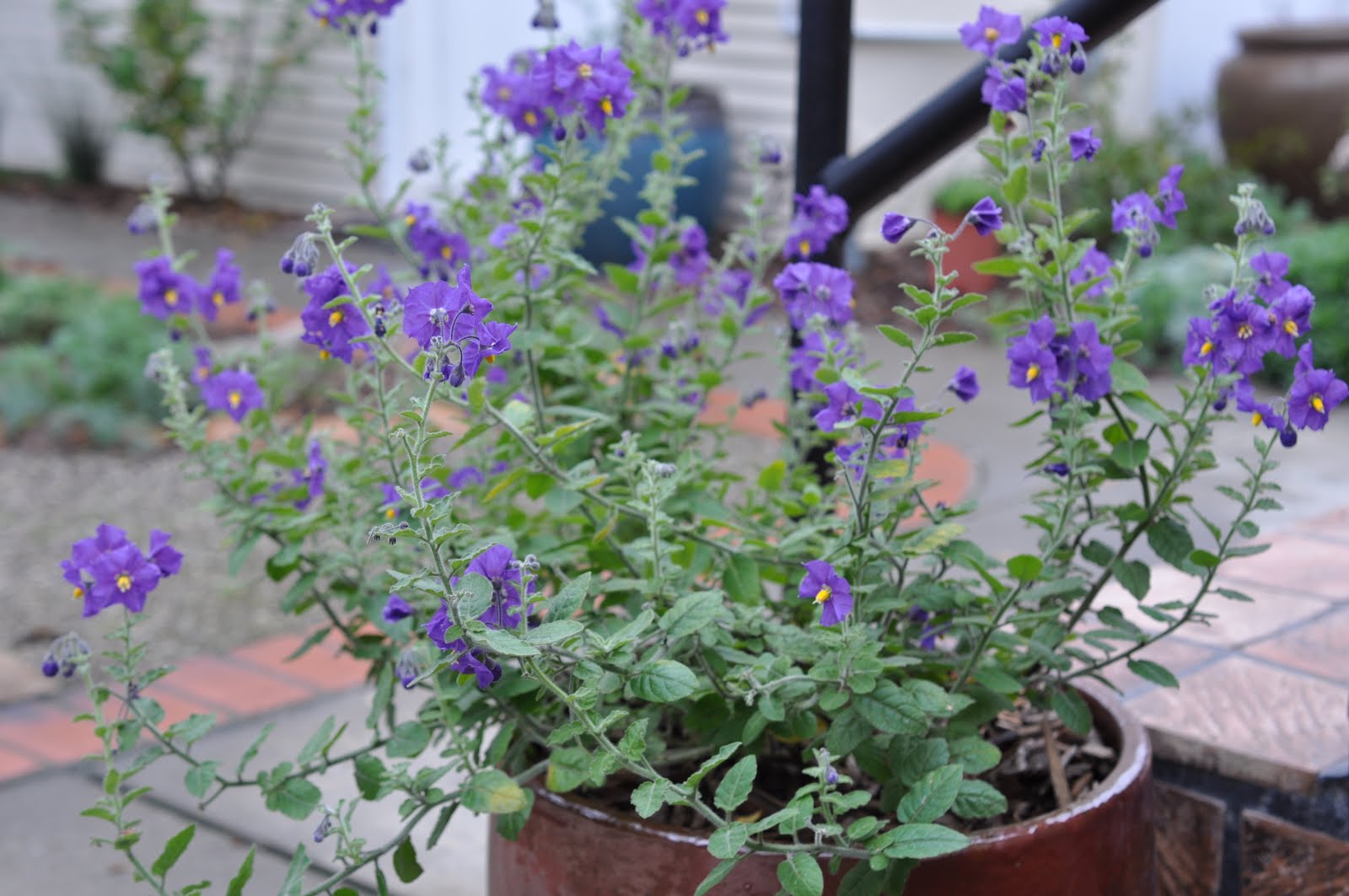
'Mountain Pride' Blue Witch (Solanum xanti 'Mountain Pride')
 
This dark-purpled selection of blue witch hails from the Santa Barbara hills. Blue witches are a common sight in chaparral and woodland environments throughout California, including here in the Bay Area at parks such as San Bruno Mountain and Edgewood. 

Solanum umbelliferum blooming in February at Edgewood

Flowers can be blue, purple or lavender, and bloom profusely over long periods in the Spring and Summer if conditions are favorable. The leaves and round green fruits of this plant are toxic. Many native plant venders recommend planting blue witches in a container rather than in the ground. I have attempted both and agree that they are much easier to manage in a pot. My plant was purchased from Yerba Buena Nursery in Half Moon Bay last year and promptly deposited in a brown glazed pot where it is happily blooming right now.


Thriving in a container in full sun
Receives drip irrigation in the dry months


Friday, March 4, 2016

Native Plant Profile: Montara Manzanita

Montara Manzanita (Arctostaphylos montaraensis)
I snapped this picture along the Montara Mountain North Peak trail last week. This majestic manzanita can only be found in the wild on Montara and San Bruno mountains, generally between 500 and 1500ft elevation.  It can be quite tall (up to 15ft) on protected slopes,  or very short (<2ft) on exposed granite outcrops*. Blooms are whitish/pink and held in dense clusters during the winter months.

Montara manzanita blanket a south facing slope on Montara mountain, Montara beach in the distance

This is one of my favorite manzanitas because (a) it's local and (b) the bright green clasping green leaves are striking to me.  I wanted to grow this shrub in my garden but it's almost impossible to find at native nurseries. A few years back my sister picked me up a one gallon plant from Central Coast Wilds in Santa Cruz. It lived in a wine barrel for a couple years, happily, and then was transplanted into the front yard this past Fall. I'm curious to see how it fares away from the coast in loamy/clay soil.

My own personal Montara manzanita
* Source: Field Guide to Manzanitas by Kauffman, Parker and Vasey


Thursday, March 3, 2016

Hiking from Waddell Beach to Sunset Trail Camp

Hiking along the Berry Creek Falls Trail
In preparation for an April two-night backpacking trip along the Ohlone Trail, I've been hiking as much as possible lately. The Ohlone Trail covers about 30 miles from Fremont to Livermore, and is rated strenuous due to the significant amount of climbing involved and the lack of shelter from the elements. I've never backpacked more than one night and have never attempted a thru-hike. I hope this will be the first of many such experiences.

My stiffest training challenge yet came on Monday when I attempted a 15 mile round trip hike from Waddell Beach to the series of falls near Sunset Trail Camp in Big Basin Sate Park. I have never hiked more than 10 miles in one day, and to make matters worse, I was carrying a geared up backpack weighing around 27 pounds. Luckily the trail, a dirt multi-use fire road, was mostly flat and shaded.

Turkey Tail fungi clinging to a rotting log, watched over by non-native Forget-Me-Nots

I was traveling along the end portion of the Skyline to Sea trail that begins near Saratoga Gap, some 30 miles away. Waddell Creek was near my side for the duration, and my surroundings consisted mainly of redwood forest and riparian habitat. Lots of ferns, horsetail, and redwood sorrel lined the wide path, and towering above were redwood, maple, alder and buckeye trees.

Horsetail and alders along Waddell Creek

The trail was very peaceful once I passed Rancho Del Oso, which was buzzing with farm equipment and littered with invasive weeds. I didn't see another hiker until about three hours into the hike on the return trip. While I love solitude, the isolation did make me feel a little uneasy. I kept imagining how I would ward off an attacking mountain lion. Luckily, I had birds, banana slugs and newts to occupy my mind and keep me company. I found myself constantly looking down at the path to make sure I didn't crush any tiny brave souls as they attempted a trail crossing.

A California newt heads for shelter under a canopy of Redwood Sorrel
Six miles into the hike I came upon Berry Creek Falls, one of the most popular hiking destinations in the Bay Area. Despite minimal rain over the past month, there was a decent amount of water flowing over the falls. I would love to see it after a series of storms.

Berry Creek Falls
Beyond Berry Creek Falls the trail narrows and climbs past Silver Falls, The Cascades and Golden Falls. This is the most scenic portion of the trail, but also the most popular, so you'll likely be sharing the experience with others. My favorite part was a steep section of damp stairs that climbed right next to Silver Falls, like a mini version of Yosemite's Mist trail.

Golden Falls
Near the Cascades in happier times, before my body started falling apart

The return trip was mostly uneventful, though I seemed to hit a wall with about 3 miles left on the trail. My feet and lower back really started aching and my water supply was running low. By the time I reached the Waddell Beach ranger station, I had registered about 30,000 steps and was about ready to collapse. Luckily there was a beautiful soft sandy beach there to catch me as I crumpled to the ground with my backpack.

Waddell Beach, final destination on the Skyline to Sea trail


Tuesday, March 1, 2016

A partly sunny bed of natives


Clumps of Douglas Iris hybrids encircle a currant shrub
The backyard is divided into various collections of plants based on their sun exposure. Some receive full sun, some part sun, and some full shade. Some are on drip irrigation, some are not. Typically these "islands" of plants feature a centerpiece shrub, raised on a berm, surrounded by colorful perennials. 

This particular plant grouping is shaded much of the day by a large avocado tree, but does receive sun at various times of the morning and afternoon. The specimen shrub of the "island" is a 3 year old 'Barrie Coate' pink-flowering currant that begins flowering in January and continues into early April. It is surrounded by several Douglas iris hybrids ranging in color from dark purple to white. These begin flowering in late February and continue to mid April. This space is also shared with two western sword ferns that lie on either side of a bird bath and California polypody plants that appear seasonally from Fall to late Spring. Finally, two 'Point Reyes' groundcover manzanitas are situated inbetween the bird bath and a step stone path. The foliage of the manzanitas is dark green, providing a nice contrast with bright green of the neighborning ferns. The manzanitas are covered with small white/pink flowers in late Winter. This bed of plants is outfitted with drip irrigation for those times of extended drought. I give them 5 minutes of water a couple times a week, just to keep them looking fresher.


Iris douglasiana 'Canyon Snow,' the first of the irises to bloom this year
Western Sword fern, Poystichum munitum

Pt. Reyes bearberry, Arctostaphylos uva-ursi 'Pt. Reyes'
California Polypody, Polypodium californicum
Ribes sanguineum glutinosum 'Barrie Coate' in February